
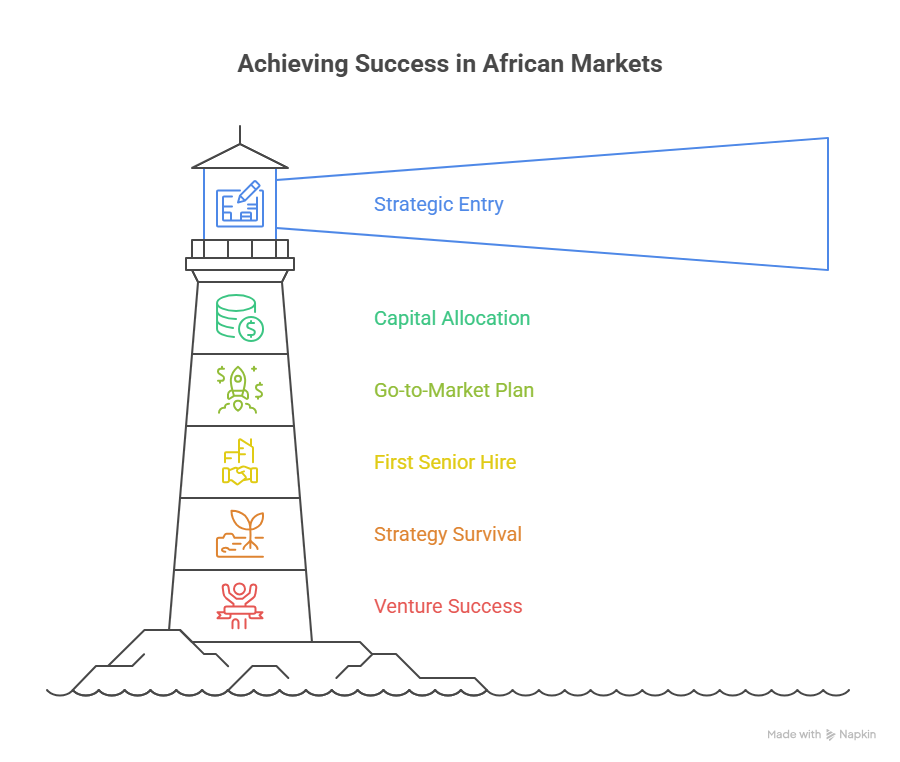
For multinationals entering African markets, one decision often determines the venture’s success: the first senior hire. This choice outweighs market-entry strategy, capital allocation, or go-to-market planning.
Selecting the right person gives your strategy a realistic chance of success. The wrong choice often leads to failure within eighteen months, frequently before headquarters recognizes the issue. Across major African cities, multinationals make this mistake far more often than they get it right.
This pattern has persisted for years. Here is why it continues and what successful companies do differently.
The comfortable choice is almost always the wrong one
When opening a first office in Africa, headquarters often prefers to send a trusted internal operator—someone familiar with company systems and culture who can be briefed quickly. This appears to be the safe option.
However, this is often the riskiest choice. Company knowledge does not substitute for market knowledge, which is critical at the point of entry.
The data on this is sobering. The failure rate of international assignments has hovered around 40% for four decades and shows no sign of improving. One long-running Right Management study found that senior executives judged 42% of overseas assignments to be outright failures. In developed markets, failure runs between 25% and 40%; in frontier and under-developed markets — which is how global mobility research still, unhelpfully, classifies much of Africa — estimates climb as high as 70%. Most of these failures surface at or before the 18-month mark, and the single most-cited cause, according to Mercer, isn’t competence. It’s cultural adjustment.
The financial exposure is brutal. A failed senior assignment typically costs between $250,000 and $1 million in direct terms, and once you add relocation, housing, schooling and hardship allowances, an expatriate package usually runs two to three times the home-country equivalent. For a senior executive, some studies put the total cost of a failed assignment at up to forty times base salary. And that’s before you count the invisible costs: the stalled strategy, the lost year of momentum, the local team that walked out the door.
Even setting expatriates aside, executive hiring is unforgiving. Research from the University of South Carolina’s Center for Executive Succession finds that roughly 40% of external executive hires fail within 18 months, and that companies frequently keep underperforming leaders in place for more than 2 years before acting. In a survey of around 150 chief HR officers, nearly half estimated the cost of a single failed external hire at between $2 million and $5 million. At the top of the house, mistakes are expensive in a compounding way.
The “parachute” problem: importing an unsuitable playbook
The core issue is not only who is hired, but also what they bring. Frequently, the first leader arrives with a mandate to replicate headquarters’ strategies. Africa, however, is not a testing ground for external strategies and is not a single market.
As McKinsey’s Acha Leke notes, there is no “one Africa.” The continent comprises 54 countries, each with unique legal systems, labor laws, currencies, languages, and consumer behaviors. Even within Nigeria, regional differences in religion, ethnicity, and economics influence business operations. Standardized approaches that treat Africa as a monolith, or equate Lagos to London, consistently fail.
Nowhere has this played out more visibly than Nigeria’s recent multinational retreat. Since the start of 2023, a striking roster of Western consumer-goods giants has exited or scaled back. Unilever stopped local manufacturing of several home- and personal-care brands. GSK wound down manufacturing after fifty-one years and moved to third-party distribution. Procter & Gamble shuttered a $300 million facility and switched to imports. Diageo sold its majority stake in Guinness Nigeria to Singapore’s Tolaram and moved to an “asset-light” model across Africa. Microsoft closed its Lagos development center barely two years after opening it.
While macroeconomic conditions were challenging—inflation exceeded 34% in mid-2024, the naira lost about 70% of its value, and foreign direct investment declined—local and Asian firms such as Tolaram, Hayat Kimya, and Fouani quickly filled the gap and succeeded. As a former Walmart Africa chairman stated, for departing multinationals, the market “doesn’t justify the effort.” Companies that succeeded localized their costs, supply chains, and leadership. Those that failed often attempted to manage Nigeria remotely.
What “right” actually looks like
The counter-examples share a common thread: empowered local leadership, given real ownership rather than a remote-control relationship with headquarters.
When Google entered Nigeria, it appointed Juliet Ehimuan as its first country manager. She stayed twelve years, rose to lead West Africa, and oversaw the localization of Google’s products and the landing of a major subsea cable in Lagos. Her framing of the work was rooted in local possibility — technology, in her words, has the power “to create a level playing field.” That is not a sentence a parachuted-in operator writes.
When Uber launched in Lagos, it initially struggled — until it brought in Ebi Atawodi, a Nigerian who had led communications at Etisalat and understood the city’s fabric. She introduced cash payments, an unglamorous decision that was decisive in a cash-reliant economy, and Uber Lagos saw supply grow roughly tenfold and demand roughly a hundredfold within six months. Her point about the model was simple: a global concept still has to be localized by people who know the city. Ownership, she said, has to stop at a local desk.
When Bolt aimed to surpass Uber in Nigeria, it hired a local country manager, reportedly through a video call without headquarters’ presence. Bolt tailored its pricing for the local market, reduced driver commissions below Uber’s, and expanded into secondary cities ahead of competitors. By 2020, Bolt captured over 60% of the Nigerian market.
There is a legitimate role for expatriate leadership — but it’s narrow. MTN’s early Nigerian CEOs were expatrExpatriate leadership can play a role, but it should be limited. For example, MTN’s early Nigerian CEOs were expatriates at launch, after which leadership transitioned to local executives. The effective approach is to use expatriates for a defined stabilization period, pair them with strong local deputies, and establish a clear handover timeline. McKinsey’s research supports this, noting that leading companies grant country managers real autonomy, hire entrepreneurial leaders, and encourage pan-African mobility to prevent insularity.
The mistakes hiding inside the mistake
Beyond the expat-versus-local question, three quieter errors sink first hires again and again.
Hiring the wrong profile for the business stage is a common mistake. A market-entry leader—someone who builds relationships and creates new opportunities—differs significantly from a scale-stage operator who optimizes established operations. Companies often hire or promote the wrong type for the stage they are in.
Misjudging compensation and incentives for senior African talent is another frequent error. Capable local country managers are often undervalued, leading companies to default to costly expatriate hires that frequently fail. In reality, senior compensation in these markets is higher and more competitive than many assume. Top local leaders have multiple options, including international opportunities, and are not passively awaiting offers.
Ignoring local-content rules until they bite. Many African countries legislate senior local hiring. Nigeria’s oil-and-gas local-content regime sets participation percentages. Kenya requires proof that no qualified Kenyan is available before issuing certain work permits. Ghana outright restricts specific employment categories to Ghanaians. Treating these as paperwork rather than strategy creates legal and reputational exposure that a first hire should have flagged on day one.
De-risking the decision that matters most
None of this means Africa is uniquely difficult to hire for. It means the first senior hire deserves far more rigor — and far more local intelligence — than the “send someone we trust” instinct provides.
Such local intelligence is rarely found through job boards. Senior leaders capable of driving successful market entry are typically not active job seekers; they are already excelling elsewhere and will only consider new opportunities through trusted relationships. Reaching them requires established networks and deep market knowledge. The World Economic Forum advises companies to stop appointing disconnected expatriate leaders and instead engage local talent who understand market nuances. In short, adapt or risk failure.
iRecruiters Africa was established to address this specific challenge.
We are a pan-African executive search firm founded on the belief that the first senior hire is too important to leave to instinct or convenience. We possess in-depth knowledge of these markets, including regulatory requirements, compensation benchmarks, cultural dynamics, and, most importantly, the people. Our networks connect with senior leaders who do not post CVs but respond to trusted outreach.
If your organization is entering an African market — or quietly worrying that your first hire may already be the wrong one — let’s talk before the eighteen-month clock runs out. We’ll help you define the profile the opportunity actually demands, benchmark it against the real market, and place a leader who can build rather than merely occupy the role.
Contact iRecruiters Africa for a confidential discussion about your market-entry leadership needs. The right first hire is transformative; let us help ensure your success.
What is the most common reason you have observed for market-entry leadership failures? Please share your experience in the comments; we review every response.